

Searching for the perfect engagement ring often means weighing beauty, ethical impact, and lasting value. For couples in the Denver area who care deeply about sustainability, understanding what makes a diamond truly special is essential. The carat represents a precise global standard for diamond weight—one metric carat equals 200 milligrams—making transparency possible for both mined and lab-grown stones. This article highlights eco-friendly options and demystifies how diamond carat, cut, and clarity work together to create personalized luxury.
Table of Contents
- What Is Diamond Carat And Why It Matters
- Carat Grading Standards And Measurement Process
- Carat Weight Versus Diamond Size: Common Myths
- How Carat Impacts Value And Luxury Purchases
- Lab-Grown Diamonds And Ethical Carat Choices
Key Takeaways
| Point | Details |
|---|---|
| Understand Carat Weight | Carat weight is a standardized measurement representing the weight of a diamond, but it does not dictate value alone. |
| Quality Over Size | The value of a diamond is influenced by cut, color, and clarity, not just weight; prioritize overall quality. |
| Myths of Size Perception | Carat weight doesn’t directly correlate to visual size; shape and cut significantly affect appearance. |
| Ethical Considerations | Lab-grown diamonds offer sustainable luxury with identical properties to natural diamonds, reducing environmental impact. |
What Is Diamond Carat and Why It Matters
Understanding diamond carat is crucial when selecting the perfect gemstone for your engagement ring or fine jewelry piece. Carat represents the standardized weight measurement for diamonds, with one metric carat precisely defined as 200 milligrams. This globally recognized standard allows jewelers and consumers to communicate diamond size with remarkable accuracy.
Diamonds are measured using a sophisticated system that subdivides carats into 100 points, enabling extremely precise weight assessments. For instance, a 0.50-carat diamond might be described as a “fifty-pointer” in jewelry terminology. Precise global weight measurements help ensure transparency and consistency in diamond evaluation.
While many assume larger carats automatically mean higher value, the reality is far more nuanced. A diamond’s worth isn’t determined by weight alone but by a complex interaction of four critical factors:
- Carat Weight: The diamond’s physical mass
- Cut Quality: How well the diamond is shaped and reflects light
- Color Grade: The diamond’s absence of color
- Clarity: The presence or absence of internal imperfections
Two diamonds of identical carat weight can have dramatically different market values depending on these additional characteristics. A smaller diamond with exceptional clarity and cut might command a higher price than a larger stone with visible imperfections.
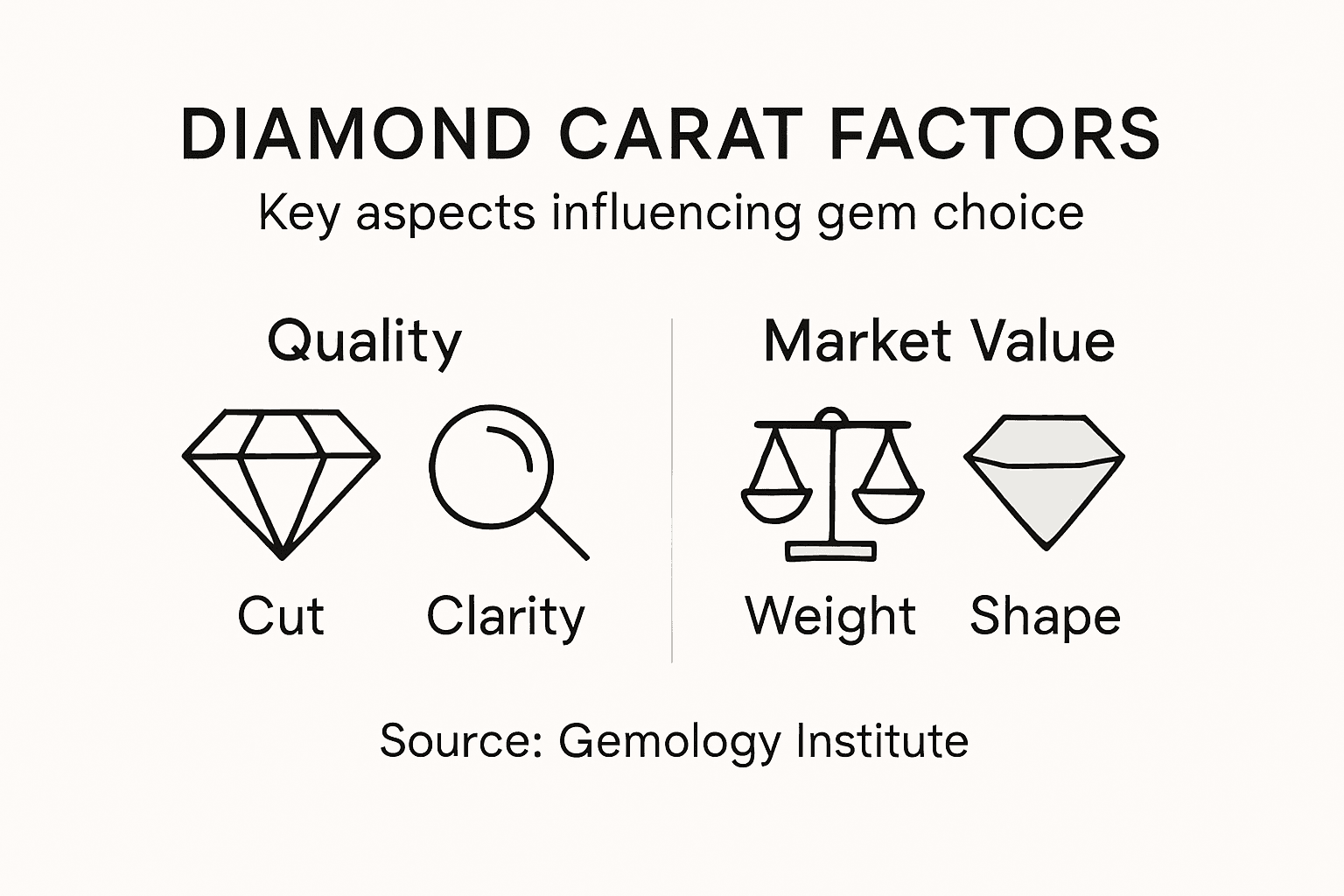
Here’s a quick reference comparing diamond carat with other key grading criteria:
| Grading Factor | What It Measures | Impact on Appearance | Market Value Influence |
|---|---|---|---|
| Carat Weight | Diamond’s mass in carats | Affects size perception | Major, especially at thresholds |
| Cut | Proportions and finish | Maximizes brilliance and fire | High with ideal cuts |
| Clarity | Internal/external flaws | Influences transparency | Moderate (very high for flawless stones) |
| Color | Presence of any hue | Impacts visual whiteness | High for colorless grades |
Historical Context: The term “carat” has fascinating origins, dating back to the 1500s when traders used consistent carob seeds as counterweights for measuring precious stones. This practice established the foundation for our modern, scientifically precise measurement system.
Pro tip: When shopping for diamonds, always prioritize overall quality over pure carat size, and consider how the stone’s cut and clarity contribute to its visual brilliance.
Carat Grading Standards and Measurement Process
The evaluation of diamond carat weight follows an incredibly precise and scientifically rigorous methodology that ensures consistent, transparent assessments worldwide. Global diamond grading standards require specialized equipment and meticulously controlled environmental conditions to achieve extraordinary levels of accuracy.
Professional gemological laboratories like the Gemological Institute of America (GIA) employ advanced electronic micro-balance scales capable of measuring diamonds to an astonishing five-decimal point precision. These sophisticated instruments undergo regular calibration and operate within tightly controlled environmental parameters to eliminate any potential measurement variations.
The carat grading process involves several critical steps:
- Initial Weighing: Measuring the diamond’s exact mass using high-precision digital scales
- Rounding Protocol: Standardizing measurements to the nearest hundredth of a carat
- Environmental Control: Maintaining consistent temperature and humidity during assessment
- Instrument Calibration: Regularly verifying scale accuracy
Professional diamond grading requires scientific precision that goes far beyond simple weight measurement.
Unlike subjective assessments, carat weight measurement is an objective process that follows internationally recognized protocols. Laboratories document these measurements on official grading reports, providing consumers with transparent, verifiable information about their diamond’s precise characteristics.
Pro tip: Always request an official grading report from recognized institutions like GIA when purchasing a diamond, ensuring you receive a scientifically validated assessment of its true characteristics.
Carat Weight Versus Diamond Size: Common Myths
One of the most pervasive misconceptions in diamond selection is the direct correlation between carat weight and visible size. Diamond shape and cut complexity dramatically influence how large a diamond appears, challenging the simplistic assumption that heavier diamonds always look bigger.

Diamond shapes play a crucial role in perceived size, with certain cuts creating optical illusions that can make a stone appear larger or smaller than its actual weight. Fancy-shaped diamonds like marquise, oval, and pear often seem more substantial compared to round brilliant cuts of identical carat weight, due to their elongated design and strategic light reflection.
For easy comparison, the table below summarizes how popular diamond shapes affect visual size for the same carat weight:
| Diamond Shape | Appears Larger (vs Round) | Typical Visual Effect |
|---|---|---|
| Marquise | Yes | Elongated, maximum spread |
| Oval | Yes | Looks bigger face-up |
| Pear | Yes | Tapered, exaggerated size |
| Round Brilliant | Baseline | Balanced, classic look |
| Princess | No | Appears smaller, deeper cut |
| Emerald | Slightly | Broad look, step facets |
The most common myths about diamond size and carat weight include:
- Weight Doesn’t Equal Size: A 1-carat round diamond might look smaller than a 1-carat oval diamond
- Cut Depth Matters: Shallow cuts can make a diamond appear larger but compromise brilliance
- Visual Deception: Some shapes create the illusion of greater size without additional weight
- Proportions Impact Perception: Diamond cutting techniques significantly influence visual size
Not all carats are created equal: shape, cut, and proportions dramatically alter a diamond’s apparent size.
Professional jewelers understand that diamond dimensions involve complex visual mathematics. The distribution of weight, angle of facets, and overall geometric design contribute more to a diamond’s visual appeal than raw carat measurement.
Pro tip: When comparing diamonds, always view them side-by-side and consider multiple angles to truly understand their visual impact, rather than relying solely on carat weight.
How Carat Impacts Value and Luxury Purchases
Understanding diamond valuation requires more than a simple measurement of weight. Diamond pricing dynamics reveal a complex relationship between carat weight and market value, where larger stones command exponentially higher prices due to their rarity.
The luxury diamond market operates on a non-linear pricing model that dramatically transforms a stone’s value as it reaches specific weight thresholds. These ‘magic sizes’ — such as 0.50, 1.00, and 1.50 carats — represent psychological and market benchmarks where prices can spike significantly, often without a proportional increase in actual size.
Key factors influencing diamond value beyond carat weight include:
- Rarity Factor: Larger diamonds are exponentially more scarce
- Price Progression: Value increases geometrically, not linearly
- Quality Interaction: Cut, clarity, and color modify carat value
- Market Perception: Certain weight thresholds carry premium status
Not all carats are financially equal: market dynamics create surprising value fluctuations.
Professional jewelers understand that diamond valuation involves sophisticated calculations considering multiple interdependent factors. The relationship between size and price is nuanced, with market demand, stone quality, and psychological thresholds playing crucial roles in determining a diamond’s true luxury value.
Pro tip: When considering diamond purchases, focus on overall quality and visual appeal rather than fixating solely on reaching a specific carat weight threshold.
Lab-Grown Diamonds and Ethical Carat Choices
The emergence of lab-grown diamonds represents a revolutionary approach to sustainable luxury, offering consumers an ethically conscious alternative to traditional mined stones. These scientifically crafted gems provide identical physical and chemical properties to natural diamonds while dramatically reducing environmental impact.
Unlike traditional diamond mining, lab-grown diamonds are created in controlled environments that minimize ecological disruption. This innovative production method ensures that each carat represents not just aesthetic beauty, but a commitment to responsible consumption. The precision of lab creation allows for consistent quality and transparency in every stone’s characteristics.
Key ethical advantages of lab-grown diamonds include:
- Environmental Protection: Significantly reduced carbon footprint
- Water Conservation: Drastically lower water usage compared to mining
- Labor Practices: Elimination of potential exploitative mining conditions
- Transparent Sourcing: Complete traceability of diamond origin
Lab-grown diamonds prove that luxury and sustainability can coexist without compromise.
Professional gemologists confirm that diamond certification for lab-grown stones follows identical rigorous standards applied to mined diamonds. Each stone undergoes comprehensive evaluation using the same 4Cs criteria — cut, color, clarity, and carat — ensuring consumers receive a product of verified quality and authenticity.
Pro tip: When selecting a lab-grown diamond, request a detailed certification report and compare the stone’s specifications across multiple quality metrics, not just carat weight.
Choose Brilliant Lab-Grown Diamonds with Confidence
Selecting the perfect diamond means balancing carat weight with ethical values and quality factors like cut, clarity, and color as outlined in the article. If you want a diamond that showcases brilliance without compromise or environmental cost, Eternal Carat offers expertly crafted lab-grown diamonds that meet these exacting standards.
Explore our bespoke fine jewelry collection where luxury meets sustainability. Each piece is designed with precision and transparency, helping you avoid common pitfalls around carat weight and size misconceptions while celebrating true value beyond numbers. Our commitment to ethical luxury means you can wear your gem proudly knowing it aligns with your vision and values.

Discover how to elevate your diamond selection experience through personalized expert consultation and our secure, private showroom in Parker, Colorado. Start your journey now at Eternal Carat and unlock access to stunning lab-grown diamonds, custom designs, and ethical luxury that lasts forever.
Frequently Asked Questions
What is a diamond carat and why is it important?
Carat is the standardized weight measurement for diamonds, where one carat is equivalent to 200 milligrams. Understanding carats is crucial because it directly influences the size and value of the diamond you are considering.
How does carat weight affect a diamond’s value?
While carat weight is a significant factor in determining a diamond’s value, it is not the only consideration. The cut quality, color grade, and clarity also play crucial roles in its overall market value and appearance.
Do larger carat diamonds always look bigger than smaller ones?
Not necessarily. The visible size of a diamond can be affected by its shape and cut. For example, fancy-shaped diamonds like marquise or oval can appear larger than a round diamond of the same carat weight due to their design.
What are the benefits of choosing lab-grown diamonds?
Lab-grown diamonds offer an ethical option without compromising quality. They have a lower environmental impact, ensure transparent sourcing, and maintain the same physical and chemical properties as natural diamonds, while also being typically more affordable.


