

Selecting an engagement ring in Denver brings more than just personal style into play. For couples who value sustainability and exquisite craftsmanship, understanding the difference between diamond cut and shape is key. The cut determines brilliance, making it the most important feature for maximizing light and sparkle. Investing in a bespoke lab-grown diamond means paying attention to cut quality, symmetry, and polish—details that transform a stone’s beauty and its lasting value.
Table of Contents
- Diamond Cut Definition And Common Misconceptions
- Types Of Diamond Cut And Grading Scales
- Key Characteristics: Proportions, Symmetry, And Polish
- How Cut Affects Brilliance And Value
- Lab-Grown Vs Mined: Cut Quality And Comparison
Key Takeaways
| Point | Details |
|---|---|
| Cut Quality is Crucial | The precision of a diamond’s cut affects its light performance and overall brilliance, influencing both appearance and value. |
| Difference Between Cut and Shape | Cut refers to the diamond’s facet angles and symmetry, while shape indicates its geometric outline, which are separate characteristics. |
| Prioritize Light Performance | When selecting a diamond, prioritize cut quality over carat weight to ensure maximum brilliance, even in smaller stones. |
| Lab-Grown vs. Mined Diamonds | Both types undergo the same cut quality evaluation, but lab-grown diamonds often offer more consistent cut quality at a lower cost. |
Diamond Cut Definition And Common Misconceptions
When it comes to diamonds, the cut represents far more than just shape - it’s the critical factor determining a stone’s light performance and visual brilliance. Diamond cut quality profoundly impacts how light interacts with the gemstone, creating that mesmerizing sparkle every couple desires.
A diamond’s cut specifically refers to the precision of its facet angles, proportions, and symmetry - not its geometric outline. Many people mistakenly believe cut and shape mean the same thing, but they’re distinctly different characteristics. The cut determines how effectively a diamond reflects and refracts light, which directly influences its overall appearance and value.
- Cut determines light performance
- Shape describes the diamond’s geometric outline
- Professional graders assess cut using strict mathematical standards
- Advanced technologies like laser cutting enable more precise diamond shaping
The most popular cut remains the round brilliant, engineered with multiple facets designed to maximize light return. This precision-crafted cut typically features 57-58 precisely angled facets that act like tiny mirrors, capturing and reflecting light in spectacular patterns. Other popular cuts like princess and emerald offer unique aesthetic variations while maintaining fundamental light performance principles.
Professional diamond cutters understand that even microscopic variations in facet angles can dramatically change a diamond’s brilliance and fire.
Pro tip: When selecting a diamond, prioritize cut quality over carat weight, as an excellently cut smaller stone will appear more brilliant than a larger poorly cut diamond.
Types Of Diamond Cut And Grading Scales
Diamond cuts are not one-size-fits-all, but rather a sophisticated art form with multiple styles and complex evaluation methods. Diamond cutting styles encompass three primary categories that dramatically influence a stone’s visual performance and aesthetic appeal.
The three fundamental diamond cutting styles include:
- Brilliant Cuts: Featuring triangular and kite-shaped facets radiating from the center
- Step Cuts: Rectangular facets arranged in precise, parallel layers
- Mixed Cuts: Combining brilliant and step cut characteristics for unique optical effects
Professional diamond grading follows rigorous assessment standards, with the American Gem Society (AGS) using a precise 0-10 scale where ‘0’ represents exceptional quality and ‘10’ indicates the lowest grade. This comprehensive evaluation considers multiple critical factors beyond simple visual appearance.

Brilliant cuts, particularly the round brilliant, remain the most popular due to their exceptional light performance. These cuts typically feature 57-58 precisely angled facets engineered to maximize light reflection, creating that coveted, mesmerizing sparkle. Step cuts like emerald and baguette styles offer a more understated elegance, emphasizing the diamond’s clarity and color through their geometric precision.
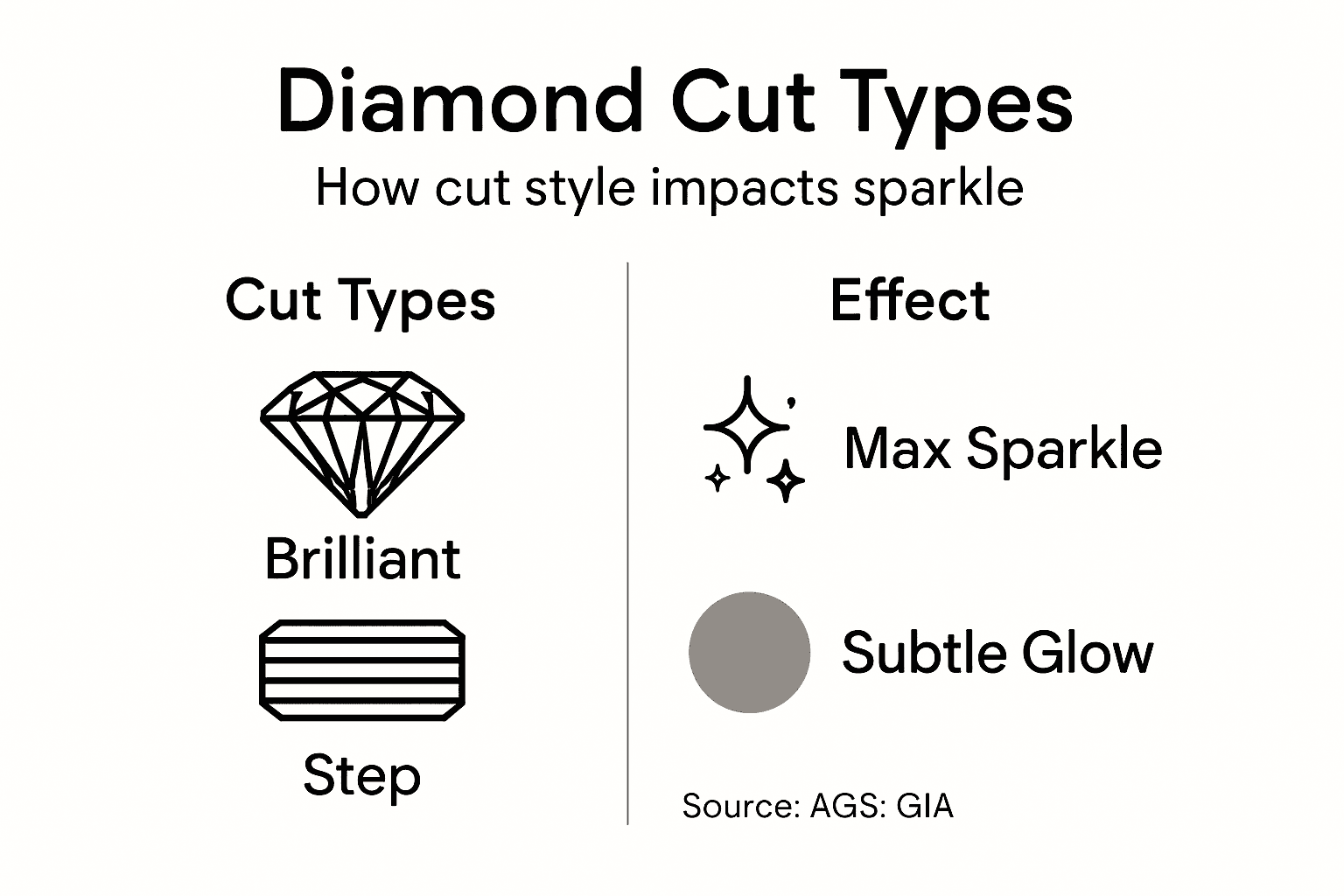
Here’s a summary of diamond cutting styles and their distinct visual effects:
| Cutting Style | Facet Shape | Optical Effect | Typical Stone Example |
|---|---|---|---|
| Brilliant Cut | Triangular, kite | Maximizes sparkle | Round brilliant |
| Step Cut | Rectangular | Highlights clarity | Emerald, baguette |
| Mixed Cut | Combination | Unique light reflection | Princess, cushion |
Professional diamond cutters understand that microscopic variations in facet angle and placement can transform a diamond’s entire optical character.
Grading experts meticulously assess diamonds across four key dimensions:
- Polish quality
- Symmetry precision
- Proportional alignment
- Light performance characteristics
Pro tip: When evaluating diamond cuts, prioritize overall light performance over individual metrics, as the interplay of facets creates the stone’s true brilliance.
Key Characteristics: Proportions, Symmetry, And Polish
Understanding a diamond’s intrinsic qualities requires a deep dive into three critical characteristics that define its ultimate brilliance and value. Diamond cut characteristics represent a complex interplay of precision engineering and artistic craftsmanship that transforms a raw stone into a mesmerizing gem.
The three fundamental characteristics of diamond quality include:
- Proportions: The precise geometric relationships between different diamond facets
- Symmetry: The exact alignment and shape of individual facets
- Polish: The smoothness and finish of the diamond’s surface
Each characteristic plays a crucial role in determining the diamond’s optical performance. Diamond surface quality is assessed through meticulous grading processes that evaluate microscopic details invisible to the naked eye. Professional gemologists examine these features using specialized equipment, looking for subtle variations that can dramatically impact a stone’s brilliance.
Proportion analysis focuses on critical measurements like crown height, pavilion depth, and table size. These elements must be precisely balanced to maximize light reflection and create that coveted internal fire. Symmetry grading ensures that facets are perfectly aligned, with even the slightest misalignment potentially reducing a diamond’s ability to capture and reflect light.
Professional diamond cutters know that perfection exists in millimeters, not inches.
Diamond polish is graded on a scale from Poor to Excellent, with top-tier stones showing:
- No visible surface imperfections
- Smooth, uniform texture
- Minimal microscopic blemishes
- Consistent light-reflecting surface
Pro tip: Request a detailed cut analysis report when purchasing a diamond, focusing on how proportions, symmetry, and polish work together to create the stone’s overall brilliance.
How Cut Affects Brilliance And Value
Diamond brilliance is not just about appearance - it’s a precise science of light manipulation that directly impacts a stone’s market value and visual appeal. Diamond optical performance represents a complex interplay of physics, mathematics, and artisan craftsmanship that transforms a raw gemstone into a breathtaking masterpiece.
The critical elements affecting a diamond’s brilliance include:
- Light reflection: How effectively facets bounce light internally
- Refraction angles: Precision of light-bending characteristics
- Light return: Percentage of light escaping versus being reflected
- Color dispersion: Rainbow-like flashes created by light separation
Gemstone brilliance mechanics reveal that a diamond’s cut quality directly determines its ability to capture, reflect, and disperse light. Professional gemologists assess this through multiple sophisticated measurements, understanding that even microscopic variations can dramatically transform a stone’s visual performance.
The round brilliant cut remains the gold standard for maximizing light performance. Its meticulously designed 57-58 facets are engineered to create maximum internal reflection, ensuring that light entering the stone bounces and refracts in a way that produces extraordinary sparkle. Poorly cut diamonds, by contrast, leak light through the sides and bottom, resulting in a dull, lifeless appearance that significantly reduces market value.
Diamond cutters are essentially light engineers, sculpting stones to create maximum optical magic.
Factors impacting a diamond’s brilliance and value ranking include:
- Precise facet angle calculations
- Symmetrical geometric proportions
- Surface polish quality
- Overall light performance metrics
Pro tip: When evaluating a diamond’s brilliance, request professional light performance images that demonstrate how the stone handles illumination from multiple angles.
Lab-Grown Vs Mined: Cut Quality And Comparison
Lab-grown diamonds have revolutionized the gemstone market, offering a compelling alternative to traditionally mined stones. Lab-grown diamond characteristics reveal a fascinating scientific approach to creating gems that are virtually indistinguishable from their natural counterparts.
Key differences in diamond production include:
- Growth environment: Controlled laboratory setting vs. natural geological processes
- Cutting precision: Potentially more consistent lab-grown stone quality
- Ethical considerations: Reduced environmental and social impact
- Cost factors: Typically more affordable lab-grown options
Both lab-grown and mined diamonds undergo identical cut quality evaluation processes, ensuring that consumers can expect comparable brilliance and optical performance. The sophisticated cutting techniques used in modern diamond production allow for exceptional light performance, regardless of the stone’s origin.
The controlled growth environment of lab-created diamonds often provides an advantage in achieving more consistent cut quality. Advanced technological processes like High Pressure High Temperature (HPHT) and Chemical Vapor Deposition (CVD) enable precise control over diamond formation, potentially resulting in fewer inclusions and more uniform cutting opportunities.
The true measure of a diamond’s beauty lies not in its origin, but in its ability to capture and reflect light.
Comparing lab-grown and mined diamonds reveals critical similarities:
The following table compares lab-grown and mined diamonds in terms of cut quality and purchase considerations:
| Factor | Lab-Grown Diamonds | Mined Diamonds |
|---|---|---|
| Cut Consistency | Highly uniform | Varies by rough stone |
| Environmental Impact | Low | Higher |
| Price Range | Lower cost | Generally higher |
| Cut Grading | Same standards applied | Same standards applied |
- Identical chemical composition
- Equivalent optical properties
- Comparable grading standards
- Indistinguishable light performance
Pro tip: When selecting between lab-grown and mined diamonds, prioritize cut quality and light performance over origin, as these factors most significantly impact the stone’s visual appeal.
Discover the Perfect Cut to Maximize Your Diamond’s Sparkle
Choosing a diamond with exceptional cut quality is essential to unlocking its true brilliance and value. As the article highlights, understanding proportions, symmetry, and polish can feel overwhelming but makes all the difference between a dull gemstone and one that captivates with every ray of light. If you are ready to prioritize cut quality and experience the full sparkle potential of your diamond, Eternal Carat offers expert guidance and a curated selection of premium lab-grown diamonds crafted with unparalleled precision.

Explore our commitment to ethical luxury and expert craftsmanship by visiting Eternal Carat today. Whether you want to collaborate on a custom design or select from our expertly graded diamonds, our team ensures your stone meets the highest standards of cut excellence. Do not wait to elevate your jewelry collection with a diamond that truly shines from within. Schedule a private consultation or browse our collections online now and see why cut matters most.
Frequently Asked Questions
What is the difference between diamond cut and diamond shape?
The diamond cut refers to the precision of a stone’s facet angles, proportions, and symmetry, affecting how it reflects light, while diamond shape describes the stone’s geometric outline.
Why is diamond cut quality important?
Diamond cut quality is crucial because it directly influences how effectively a diamond reflects and refracts light, which affects its overall appearance and market value.
How do different diamond cutting styles affect visual performance?
Different cutting styles, such as brilliant, step, and mixed cuts, create varying optical effects, influencing sparkle, clarity, and the overall aesthetic appeal of the diamond.
What factors should I consider when evaluating a diamond’s brilliance?
When evaluating a diamond’s brilliance, consider aspects like facet angle precision, symmetry, surface polish quality, and overall light performance metrics.


